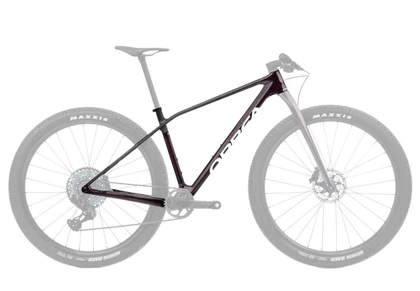


Escapa presents the Orbea Orca OMX Replica Lotto Dstny 24 Frame, the ideal foundation for building a bike for cyclists who love climbing and want the best bike to conquer mountain passes. It’s also perfect for those seeking the acceleration, agility, and responsiveness that only a truly lightweight bike can offer.
Plus, it looks exactly like the bike ridden by the professional riders of the Lotto Dstny team.
The Orbea Orca OMX Replica Lotto Dstny 24 Frame isn’t just lightweight. It’s designed to change the way you reach the summit. With the Orbea Orca OMX Replica Lotto Dstny 24 frame, you have the foundation to build a bike so light and efficient that it delivers an unbeatable riding experience: instant acceleration, vibration absorption, and exceptional responsiveness—all made possible by a frame that feels light yet rigid when needed. Its design is geared toward high performance and is timeless; never before has such an aesthetic and such extraordinary riding sensations been achieved with so little. Orbea invites you to welcome the ultimate climber: “Praise the light!”
PRAISE THE LIGHT: Orbea Unveils The New Orca
● Orbea’s new road flagship is designed with weight in mind and delivers the best possible climbing performance: instant acceleration, highly agile handling, vibration absorption, and excellent power transfer.
● The 7th generation of the Orca is a lightweight bike designed for climbers, featuring a high-performance design.
What sets the Orca apart from the rest?
● Orbea Racing Philosophy
Orbea always forges its own path, and in the road bike category, it advocates for a clear distinction between bikes designed for specific purposes. They argue that the most efficient aerodynamic bikes can never be truly lightweight, and likewise, the lightest bikes can never be super aerodynamic.
"A super-aero bike requires fewer watts at high speeds. But as the gradient increases and speed decreases, the effect of gravity overpowers air resistance, and the lightweight bike gains the advantage. To demonstrate this, we’ve conducted efficiency tests at both low and high speeds. Low-speed efficiency tests measure the number of watts required to maintain a given speed on a steep climb. This test removes aerodynamics from the equation. To perform well, bikes must be lightweight and efficiently transfer power from the cranks to the wheels,” says Joseba Arizaga, Road Product Manager at Orbea.
“The other side of the equation is the high-speed efficiency test. At the velodrome, we measure the watts required to maintain a high speed, where aerodynamics play a dominant role. To perform well, bikes must minimize aerodynamic drag. Reducing weight by 500 g on a 5% grade saves about 3 W. If the grade increases to 10%, the savings rise to about 6 W. At higher speeds, aerodynamics take over. Thus, at 30 km/h, a super-aerodynamic bike saves about 12 watts; at 40 km/h, 15 watts; and at 50 km/h, about 28 watts. That’s why increasing the weight of a lightweight bike in exchange for aerodynamic performance makes no sense. On climbs, the lighter the bike, the better; and at high speeds, the more aerodynamic, the better. A medium-weight bike with aerodynamic features doesn’t win anywhere,” explains Arizaga.
Orbea claims that the Orca is about 3W faster than an aero bike ridden by an average cyclist on a 5% grade, and about 6W faster on a 10% grade. Adding partial aerodynamic features—and thus more weight—would jeopardize those advantages and diminish that special feeling of lightness, agility, and responsiveness.
● Pure Light
Orbea has paid close attention to every detail to achieve the necessary lightness. The lighter the frame, the more difficult it is to shed weight without sacrificing anything. Taking the Orca project to the ultimate in lightness required an obsession with detail. All this work has resulted in a 750g OMX frame in size 53 and a 360g fork.
Eliminating Overlaps
A carbon frame is made up of precisely cut carbon pieces arranged in a specific pattern before being bonded with epoxy resin. By design, there can be no gaps between the carbon pieces, which means they all have to overlap slightly. Therefore, by using larger pieces while trying to reduce their number—as we do at Orca—we have fewer overlaps, which saves grams. Of course, this adds to the workload, meaning the layup process must be more precise and takes longer, but as a result, our carbon OMX uses 90 fewer carbon pieces.
Focusing on Shapes
The epoxy needed to hold the carbon pieces together must also be precisely controlled. Excess epoxy can accumulate in corners or on sharp edges. By carefully designing the frame to prevent excess epoxy from accumulating, Orbea eliminates unnecessary material and saves grams.
● Weight-to-stiffness ratio
Orbea explains that it’s possible to build very lightweight bikes; however, it wouldn’t make sense to sacrifice pedaling efficiency due to a lack of stiffness. When designing the Orca, they started with a stiffness target to ensure that even the strongest climbers could count on efficient power transfer. They then designed the Orca to be as lightweight as possible without compromising that target.
A key feature is the Powerspine design. With this design, the lower part of the frame bears the vast majority of the torsional and lateral loads from pedaling. The head tube, down tube, and chainstays resist twisting forces and transmit power to the rear wheel, while also adding precision to the steering. All of this allows Orbea to save weight in other parts of the frame without compromising stiffness.
● Lightness on the Road
The feeling of riding a lightweight bike is unbeatable: it’s that combination of instant responsiveness and agility. On climbs, the new Orca is undeniably fast, but its lightness is also evident in its agile handling and the sensation of acceleration when pedaling.
Much of this agility is due to the Orca’s geometry, which remains virtually unchanged. Shorter chainstays—and, consequently, a shorter wheelbase—are the only modifications. This gives the bike the responsiveness and agility we demand from a climbing bike. The frame’s more rounded sections help reduce vibrations, conserving energy on longer rides. The increased tire clearance allows for tires up to 32 mm, which maximizes traction and comfort while also reducing rolling resistance.
● Aerodynamics
Although aerodynamic features aren’t a key focus on this bike, Orbea hasn’t overlooked the marginal gains that can be achieved. They maintain that they choose the most aerodynamic solution whenever it doesn’t compromise weight or handling feel. An example of this is the ICR internal cable routing, carefully engineered to reduce aerodynamic drag. The new seatpost clamp mechanism, in addition to being simple and effective, is carefully designed to reduce the surface area and improve aerodynamics. And although the fork is designed to minimize weight, its shape also helps reduce aerodynamic drag.